
Identify a Spalding County Owner
Finding an owner in Spalding County is really a short chain of proof. Start with an address and end with a deed. The AssuranceWeb search takes several entry points. A street address works, as does an owner or company name, a bill number, or a parcel. Carry the parcel number into every later step. Street spellings and owner names shift, but the parcel ID stays steady through assessment records and deed records alike.
- Search the situs address and open the matching parcel card. Copy the parcel ID, exact owner label, mailing address, tax year, and data date.
- Search the owner as grantee in the GSCCCA Real Estate index. Compare the latest deed's book/page and legal description with the parcel.
- Check whether a newer deed names another grantee. If so, the conveyance can be newer than the assessment roll.
- For a company, preserve its full legal name and check the Georgia business search for public entity context.
- Use the tax-mailing address only for a lawful, property-related contact. Do not treat it as proof of residence.
One caution about deeds. A single deed can transfer only a sliver of a tract, an easement, or a partial interest rather than the whole property. Compare the land lot, district, subdivision, lot, plat reference, acreage, and prior-deed references, and when a match still looks shaky, ask the Clerk to confirm the official book and page.
Trace Spalding County Address Clues
A sample Spalding property card shows how easily two addresses get confused. Parcel 26401008H lists 200 Luke Drive as the physical site. It also lists 4104 W Ellis Road as the owners' mailing address. Both can be right. The situs is simply the land's assigned location. The mailing address is where the tax bill and other notices go. Neither line alone proves who actually lives on the property.
A postal city name is only an index clue too. Griffin mailing addresses reach well past the city limits. A Sunny Side or Orchard Hill label does not settle a municipal boundary either. Before concluding anything about city limits, check more than one source. Look at the taxing district, the map, and the permit authority.
Open Spalding County Owner Results
The official QPublic assessor gateway pulls the pieces together. From it you can reach the parcel viewer, GIS map, tax roll, sales and appraisal data, and the forms that support a full Spalding County property search.
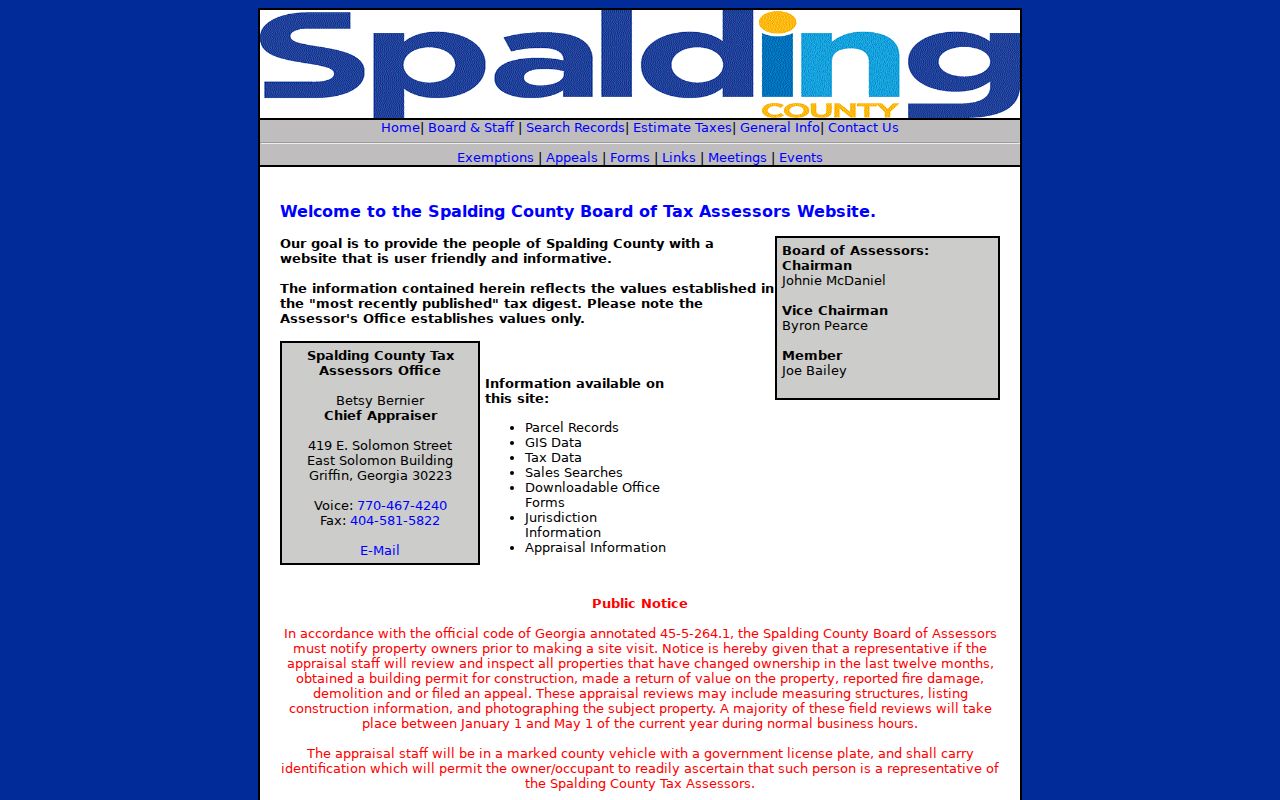
A gateway result only starts the trail. Check the record date, note the parcel ID, and read any disclaimer on the screen before you move on to the deed index.
Spalding County Ownership Evidence
No single source settles the question of who owns a piece of Spalding County land. The assessment roll is the quickest stop. It centers everything on the parcel number. A deed, by contrast, is the recorded conveyance itself. It carries the most weight. State entity filings can explain a business label, though they prove nothing about title. A GIS map shows neighboring tax parcels, not legal possession.
| Source | Owner Info It Gives | Access |
|---|---|---|
| Assessor parcel card | Published owner label, situs, mailing address, parcel ID, and card date | AssuranceWeb or QPublic |
| Recorded deed | Grantor, grantee, legal description, recording date, and book/page | GSCCCA and Clerk |
| Georgia entity filing | Business status, registered office, agent, and public filings | Secretary of State |
| Parcel map | Selected tract, nearby IDs, roads, and visible map context | QPublic map |
Each office holds one piece of the picture. The Spalding County assessor sets values and maintains the roll. The Tax Commissioner bills and collects. The Clerk of Court records deeds. A tax bill, permit, or utility file can support an address or a party name. Still, none of them substitutes for the recorded deed. Occupancy is a separate matter these owner systems never address.
When Spalding Ownership Just Changed
Spalding County follows no fixed schedule for folding new transfers into the tax roll. Assessment staff review parcels whose ownership changed in the prior twelve months. They do this during routine field and digest work. Because of that lag, a polished parcel card can sit months behind a fresh recording. Even the official sample card carried older events. That is a good reminder to note a source timestamp when you rely on one. The GSCCCA real-estate index for Spalding tends to run a few days behind the Clerk's recording counter. That gap shifts. When a recent sale matters, compare both dates. If the newest instrument is critical, call the Spalding County Clerk before drawing conclusions.
Note: A current assessment owner and a newer deed grantee can differ without either search screen being defective.
A security deed, assignment, cancellation, or release at the top of the index is not a transfer of ownership. Those instruments deal with a loan. They do not deal with the land. To settle who owns the property, hunt for the newest deed that truly conveys the tract. Then read any reference to an earlier deed it builds on.
The deed still has to match your subject. Check acreage and subdivision details against the parcel. Watch for wording that conveys only one tract, an easement, or a partial interest. A recent date proves little. The instrument may cover a different piece of Spalding land or a limited right.
Define Spalding Ownership Terms
Four record terms keep the owner-finding route clear.
- Owner of record
- The party named as owner in the record currently being consulted.
- Grantee
- The party receiving the interest described in a deed.
- Vesting
- The deed language that names who receives title and in what capacity.
- Situs address
- The physical location assigned to the land, distinct from an owner's mail destination.
- Parcel ID
- The assessor's local key for a tract; it is not a substitute for the deed description.
Resolve an Incomplete Spalding Owner Trail
If the address search stalls, tidy the street data first. Shorten suffixes like "Avenue" to "Ave." and standardize directionals. Then try again by owner name, company, or parcel number. Spalding County property records mix several parcel styles. Some are compact, some carry spaces, hyphens, or suffix letters. The county publishes no single rule for parsing them. Copy the identifier exactly as the source prints it.
Missing an image or an unindexed deed file? Head to the Clerk's counter, or file a precise request through Spalding JustFOIA. Name the deed, plat, or permit file you want. Give the parcel number, book and page, date range, and custodian. Georgia's records law usually demands a response within three business days. It never forces the county to research a custom title answer for you.
Avoid Spalding Owner Name Errors
A shared surname proves little. Common names in Spalding County demand extra proof. Anchor any candidate owner to the parcel ID and the legal description. Add the subdivision, lot, acreage, and a prior-deed reference before accepting the match. Start with the last and first name in the index. Then widen the search to middle initials and spelling variants. Trusts need their exact trustee and trust wording kept intact. Estates call for searches on the deceased owner, the estate name, and the executor or administrator capacity.
Companies deserve equal care. AssuranceWeb offers a Company search mode. GSCCCA indexes whatever name appears on the instrument itself. A tax card may carry an abbreviation that differs from the full legal entity name. The Secretary of State record helps normalize that name and identify a registered agent. An agent is not automatically the owner of record.
Read Spalding Conveyance Fields
The newest matching deed should give up several fields. Expect an execution or recording date, grantor, grantee, legal description, book/page, and often consideration or transfer-tax clues. A prior-deed reference can confirm continuity in the chain. Read every tract and exception carefully. One filing may convey a small strip, reserve an easement, or transfer a partial interest. It may also bundle several parcels together. The grantee line alone never proves the whole parcel changed hands.
GSCCCA supports both a party-name route and a book/page route. Images may require account or payment access, and live prices can change. An image may be missing. The reconstructed index may also look inconsistent. In either case, request the official instrument from Clerk real-estate processing at 770-467-4356. State plainly whether a plain or certified copy is needed. Identify the exact deed yourself rather than asking the office to decide ownership.
Corroborate a Spalding Property Owner
Tax and permit records test a lead. They never replace title evidence. The Tax Commissioner account may link the parcel to billing, exemptions, delinquency, or tax-sale status. County or Griffin permit files can tie together an owner, applicant, contractor, address, parcel, and project. Remember that each record serves its own purpose. A tax notice conveys no land. A permit applicant need not be the owner of record.
Probate offers another route when an estate surfaces in the chain. A will or estate file may establish the authority of an executor or administrator. But the land still moves only through the recorded instrument. Court dockets can reveal quiet-title, boundary, foreclosure, lien, or condemnation disputes. Always trace a docket entry to the filed order or deed. Revise an ownership conclusion only then.
Limits of Spalding Owner Findings
A public result has real limits. It can identify the party on a parcel card. It can also identify the grantee named in a deed. It cannot guarantee present occupancy or settle an adverse claim. It cannot locate an unrecorded interest. And it cannot replace a title examination. A tax-map line is not a survey. A business agent is not necessarily the person who controls the parcel. Protected identifiers and unrelated private details should stay uncopied. Even when a scanned document opens easily, leave them alone.
When timing and exact vesting need closer review, apply the current Spalding County owner record method. For a binding transaction or disputed title, obtain official records and qualified professional help.
Lawful use. Owner information supports purchase diligence, estate work, boundary questions, and civic research. Never use it to target, stalk, intimidate, or harm a person.