
Separate the Spalding County Value Figures
The Spalding County Board of Tax Assessors sets fair market value under Georgia's assessment rules. The Tax Commissioner's office is separate. It applies taxable assessed value and millage to calculate the bill. The commissioner never decides the underlying appraisal. Reading each field by its label avoids the common mistake of treating the assessed amount, full market value, and last recorded sale as the same thing.
| Value | What It Is | Where |
|---|---|---|
| Fair market value | The assessor's estimate of an arm's-length knowledgeable-buyer/willing-seller value | QPublic parcel record and assessment notice |
| Assessed value | Ordinarily 40% of fair market value before exemptions or special treatment | Assessor record and tax bill |
| Recorded sale price | Consideration or sales-history evidence tied to a particular transaction | Deed/PT-61 trail and parcel sales history |
| Land and improvements | Separate components assigned to the site and taxable structures | Detailed assessor card |
Georgia assesses ordinary real property at 40% of fair market value. The governing standard is O.C.G.A. §48-5-7 guidance. The ratio is only the default, though, because exemptions, conservation or current-use programs, historic or forest treatment, and classification can change the taxable comparison, so multiplying one field does not always rebuild the bill.
A Spalding Parcel Card Shows Why Labels Matter
The official sample card for parcel 26401008H teaches the lesson well. It covers a 57.73-acre tract at 200 Luke Drive. The mailing address differs, sitting on West Ellis Road. The card shows $244,424 in assessed and land value. A March 31, 2022 sale entry lists $345,000. The gap between those numbers is not an error. One is an assessment field. The other describes a dated transaction.
That sample PDF was uploaded July 28, 2023 and also lists earlier sales, and its data can lag behind a newer deed, permit, or assessment event, so save the timestamp whenever you compare a Spalding County property value.
Note: Keep owner mailing address, property situs, value year, and sale date in separate worksheet columns.
How Spalding County Applies Georgia's 40% Level
For an ordinarily assessed parcel, the math starts with the assessor's full fair market value. The state 40% level then applies. A hypothetical $250,000 fair market value would produce $100,000 in assessed value before exemptions. The example is arithmetic only.
- Fair market value
- The assessor's full-value conclusion as of the annual valuation date.
- Assessed value
- The statutory percentage of fair market value used as the starting taxable base.
- Net taxable value
- The assessment remaining after qualifying exemptions or special treatment.
Millage belongs to the later tax calculation. One mill equals $1 per $1,000 of assessed value. A shift in a county or municipal rate does not prove the underlying property value rose or fell.
Read Land and Improvement Value Separately
A detailed assessment can split the appraised total into land and improvements. Land reflects the site itself. Improvements capture buildings and other taxable additions. A permit, demolition, fire damage, parcel split, new construction, or field review can move one component while leaving the other flat.
Spalding appraisal staff field-review parcels after an ownership change in the preceding 12 months, or after a building permit, returned value, fire damage, demolition, or appeal. Normal review runs mainly January 1 through May 1. Those events explain why two tax years differ. The parcel record and the notice identify the actual reason.
Look Up a Spalding County Property Value
Start with the official assessment systems. AssuranceWeb takes name, bill, company, parcel, and location searches. QPublic adds parcel records, GIS maps, tax data, sales search, forms, and appraisal guidance, and the year shown with the value of record is the one to preserve.
- Search the physical address; if formatting fails, shorten the street name or use the parcel ID from the map.
- Open the parcel detail and record the tax year, fair market, assessed, land, improvement, exemption, and classification fields actually shown.
- Review the dated sales-history rows, then verify a relevant transfer through the GSCCCA real-estate index and Clerk record.
- Save the page date or upload timestamp and compare the same fields across years.
An online page can fail. The Board of Tax Assessors sits at 419 E Solomon Street in Griffin, reachable at 770-467-4240 during weekday public hours from 8 a.m. to 4:30 p.m. Ask for an existing parcel card by parcel number and year. Have that number ready. Staff do not create valuation reports.
The official QPublic entry page gathers the county's property records, maps, tax data, sales tools, and appraisal guidance in one place:
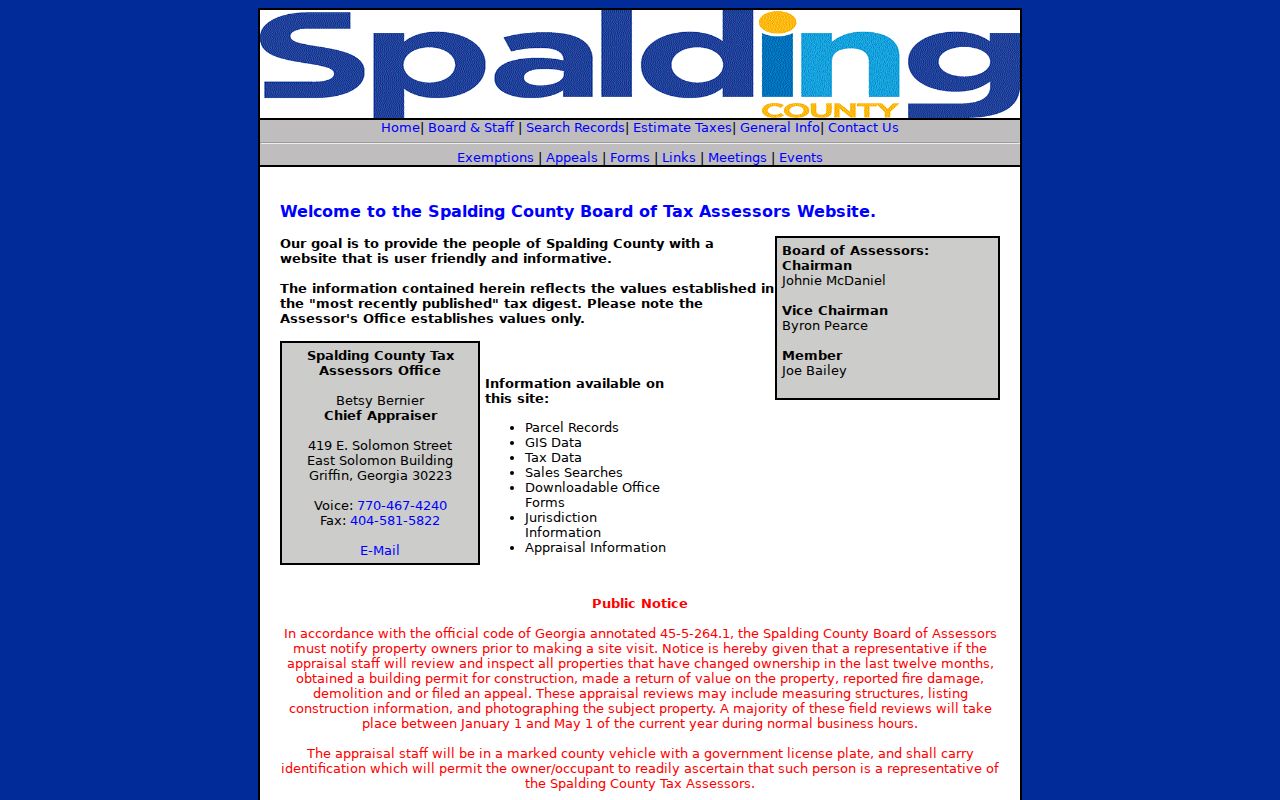
Treat that page as an entry point only. The valuation evidence is the year and value labels on the live parcel detail, not the landing screen.
Use a Sale Price as Dated Transaction Evidence
A sale price reports one conveyance, not today's market. Confirm the recording date, parties, and instrument type. Also confirm the book and page, and whether the assessor marks the sale qualified. Family transfers, estate instruments, partial-interest deeds, nominal consideration, and related-party transactions can be poor comparisons.
The newest recorded deed may also predate the next assessment roll update. The two systems do not refresh together. The local GSCCCC good-through indicator has shown deed indexing running roughly three days behind. Spalding publishes no fixed assessor-refresh lag. Match source dates before assuming the records align.
Note: A deed's consideration and an assessor sales-history row should be reconciled, not silently treated as identical.
Exemptions Can Change the Taxable Comparison
Homestead relief, age or disability relief, and veteran provisions can affect the taxable base. Conservation and current-use agriculture, historic, forest, and environmental programs can affect the valuation method. The Spalding exemptions page describes the categories. The current notice and the Tax Commissioner determine what applies in a given year.
Homestead generally requires ownership and occupancy as the legal residence on January 1. Application is due by April 1. A missed timely application normally affects the next tax year. The result can look odd. Two similarly appraised homes can carry different net taxable values. Neither fair market value is wrong. An exemption, not an appraisal error, made the difference.
Anchor Every Spalding Comparison to January 1
Georgia assessors set values each year, and January 1 anchors both ownership and valuation. Owners can file a return between January 1 and April 1. A return renews automatically afterward. Only a change in the property or a declared value forces a new filing. Market evidence arriving mid-year may shape the next cycle. But it never moves the date stamped on the current digest.
Match the parcel identity before comparing one year to the next. A lot split, a combination, a suffix letter, rezoning, or new improvements can make a line look steady. Meanwhile the property itself shifted. Plat lines and the legal description settle that question better. A street address never will.
Challenge the Assessed Value Through the Notice
Spalding County's official appeals page showed 2026 assessment notices mailed June 8. Written appeals were due July 23, 2026. That deadline has passed. Do not carry it into another cycle. Each notice controls the 45-day filing window. It also sets the route through the Board of Tax Assessors and Board of Equalization.
The Georgia PT-311A accepts grounds such as value, uniformity, taxability, exemption denial, covenant breach, or covenant denial. The form asks the owner to state an asserted value. Hold onto the notice, filing proof, parcel card, comparable sales, photographs, permits, and any evidence of condition or use.
Deadline controls. Read the date on the current assessment notice; a prior year's Spalding County appeal calendar cannot extend the present filing window.
Request the Underlying Spalding Valuation Record
If the portals skip the year or supporting file you need, ask the assessor for an existing record. Give the parcel ID, situs, owner name, tax year, and a description of the document. Non-indexed county material can be requested through Spalding JustFOIA.
Georgia's Open Records Act is O.C.G.A. §§50-18-70 et seq. It generally requires a response within three business days. The reply states availability, estimated time or cost, or the basis for withholding. State guidance makes the first 15 minutes of search and retrieval free. Copying commonly runs $0.10 per page. The agency need not build a custom analysis. So name the record you want rather than asking staff to calculate a private estimate.
Know What the Assessor's Value Cannot Prove
County appraisal is mass appraisal built for uniform taxation. It is not a property-specific inspection for a purchase, an engineering opinion, a survey, a title examination, or a promise of what a sale might bring. Physical condition, easements, financing, unusual terms, and events after the valuation date can all move a real transaction.
Value is not price. A Spalding County assessor value does not establish what a parcel will sell for; obtain appropriate appraisal and title work for a transaction.
Need the search fields explained instead? The property search guide breaks them down. For the actual bill, turn to Spalding County property tax records.