
Fields in Spalding Tax Records
Tax records and the assessment roll work as a pair in Spalding County. The Board of Tax Assessors sets taxability, fair market value, and equalization. The Tax Commissioner handles billing and collection. Millage rates come from the county and school bodies.
| Field | What It Shows | Where |
|---|---|---|
| Fair market value | Assessor's full-value estimate | Assessment record |
| Assessed value | Ordinary 40 percent assessment base | Assessment record |
| Exemptions | Approved reductions or special treatment | Assessor |
| Bill and status | Charge, payment, balance, or delinquency | Tax Commissioner |
| Taxing district | Jurisdictions affecting the levy | Parcel and bill records |
Georgia law generally assesses property at 40 percent of fair market value under O.C.G.A. §48-5-7. From there, subtract any exemptions before applying millage. Keep in mind that a recorded sale is transaction evidence, not an automatic trigger for the next assessment.
Search Spalding Assessment Fields
AssuranceWeb takes Name, Bill #, Company, Parcel, and Address as search terms. Owner-name matching lets you choose Starts With or Contains. Pick the tax year carefully, because property tax records are year-specific. Search by address, then open the parcel. Note the owner, parcel ID, district, acreage, land and improvement values, total value, exemptions, and sale history.
Parcel IDs sometimes carry spaces or a suffix letter, so copy the displayed version exactly. A situs address can differ from the owner's mailing address too. Neither field alone proves who lives there. For official tax and assessment entry points, use the county QPublic page.
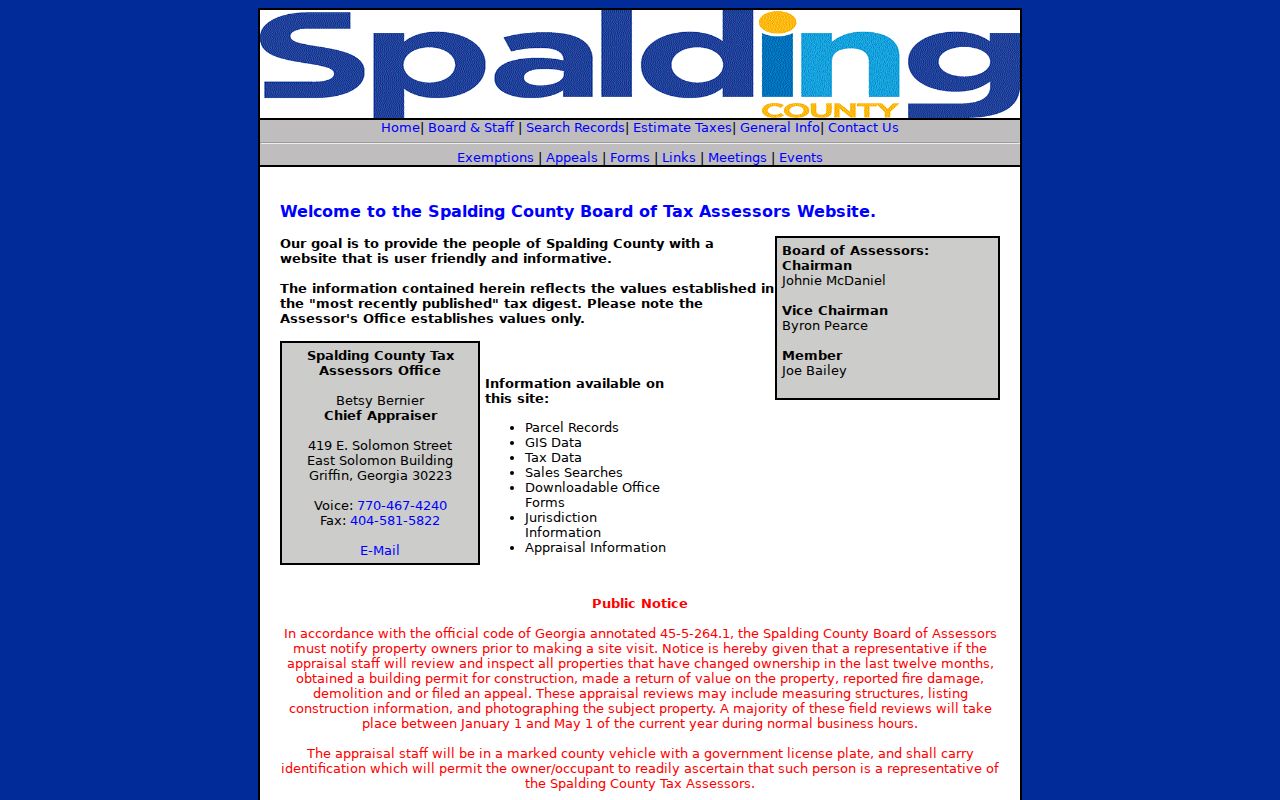
The official county assessment page ties each parcel and tax year to its collection record.
Calculate Spalding Property Tax
The county FAQ lays out the arithmetic. Fair market value times 40 percent gives assessed value. Exemptions cut that down to a net taxable figure. Millage then applies, and one mill means one dollar per $1,000 of assessed value. Classification rules and special programs can bend a simple calculation, though.
That is why two similar parcels can carry unequal tax bills. A homestead exemption, city jurisdiction, a school levy, conservation treatment, or a different valuation each nudges the result. Always work from the exact year and taxing district shown on the account.
Findings that earn a section: the assessor portal's real search fields (render the table); the reassessment cycle and the appeal calendar with forms; the exemption list and how to apply; delinquent-tax lists and tax-sale records; the mill/levy breakdown; a recent revaluation news item. -->
Look Up a Spalding Tax Bill
Start at the Tax Commissioner's Search & Pay Taxes route, which leads into AssuranceWeb. Enter an address or parcel number first. Then match owner spelling, tax year, and parcel ID against the assessor card. Trust the result only after that check. Read the current bill along with any prior-year or payment history the account shows.
- Search the official account by address or parcel number.
- Confirm the tax year, owner label, and taxing district.
- Compare assessed value and exemptions with the assessor record.
- Save payment status and investigate any delinquency or sale notice separately.
- Assessed value
- The statutory fraction or basis used before exemptions and millage.
- Mill
- One dollar of tax per $1,000 of assessed value.
- Homestead exemption
- Approved relief tied to a qualifying principal home.
- Tax lien
- A legal claim arising from unpaid property tax.
Spalding Due Dates and Delinquency
Real and business personal-property taxes in Spalding County are normally due November 15, according to the Tax Commissioner FAQ. Georgia DOR county guidance cites December 20 as a general statutory date. It cautions that local dates vary. When they conflict, the current Spalding bill controls.
No late fee applies until 60 days after mailing, the FAQ reports. Interest then begins, with a 5 percent penalty every 120 days up to 20 percent. A stated exception covers homesteaded liability below $500. These rules can change. So confirm current application with the Tax Commissioner before relying on any calculation.
Homestead and Special Treatment
Spalding County publishes details on homestead, age-based, veteran, disability, conservation, and other exemptions. Most owners file by April 1, though each program sets its own eligibility. A separate return period runs January 1 through April 1, and returns auto-renew unless a change or a declared value demands action.
An exemption touches taxable value only, never the deed or parcel boundary. Current-use, conservation, forest, and historic treatment can also make a plain 40-percent comparison misleading. Always verify the code and amount actually posted for the year you selected.
Spalding Tax Sales Are Separate
The Tax Commissioner's tax-sale page posts sale, advertising, bidder-registration, and excess-funds information. A name on the list signals a collection process underway. It says nothing about clear ownership or market availability. Confirm the parcel, defendant in fi. fa., advertised date, and status directly with the office.
A tax deed may later enter the Clerk's real-estate record, while court files or redemption issues add their own context. Never mistake the sale list for a title report. Follow the recorded instrument and get legal advice when rights are at stake.
Municipal Rates Need Labels
Historical reports list different municipal rates for Griffin, Orchard Hill, and Sunny Side. Orchard Hill fell from 5.59 in 2023 to 5.07 in 2024. Sunny Side dropped from 6.00 to 5.56. Treat those numbers as dated millage context, not property appreciation rates.
A lower rate can still pair with a higher bill when assessed value rises or other levy components shift. Keep the year, jurisdiction, school and county components, exemption status, and taxable base beside any millage figure you cite.
Annual Spalding Assessment Work
Property is valued as of January 1. The assessor reviews parcels with an ownership change in the prior 12 months, a building permit, returned value, fire damage, demolition, or appeal. Normal field review is mostly January 1 through May 1 during regular hours, using marked vehicles and identification.
This work explains why value may change without a sale and why a fresh deed and published owner label may not update together. Spalding gives no fixed transfer-to-roll lag. Save the year and timestamp with every result. Owners may generally return property from January 1 through April 1, but the Board determines value.
Distinguish Sale and Tax Value
A sale price records a transaction. Fair market value is the assessor's full-value estimate. Assessed value is the statutory tax basis, commonly 40 percent for ordinary Georgia property. Net taxable value reflects approved exemptions or special treatment.
The sample parcel shows a 2022 sale of $345,000 and a separate assessed or land amount of $244,424. Do not force them into equality. Preserve the land, improvement, total, class, acreage, exemption, and year labels. For the bill, carry the correct taxable figure and district into the commissioner's record.
Contact Spalding Tax Offices
The assessor sits at 419 E Solomon Street in Griffin, phone 770-467-4240, with published weekday hours of 8 a.m. to 4:30 p.m. Ask there about parcel facts, value, class, returns, exemptions, or appeals.
The Tax Commissioner is at 411 E Solomon Street in Griffin, phone 770-467-4360, with the same published public hours. Ask about bills, payment, delinquency, tax sales, or excess funds. Give either office the parcel ID and tax year.
Appeal a Spalding Assessment
An owner may appeal value, uniformity, taxability, or exemption within 45 days of the annual notice. The appeal goes to the Board of Tax Assessors and may proceed through the Board of Equalization, arbitration, or another available route. State form PT-311A provides a standard filing format.
Spalding reported mailing 2026 notices on June 8, with a July 23, 2026 deadline. That date has passed. A later notice carries its own controlling deadline. Keep proof of timely filing and submit comparable sales, photographs, repair evidence, measurements, or uniformity data that addresses the chosen ground.
The official Spalding appeals page publishes the cycle-specific instructions. Check it before any filing.
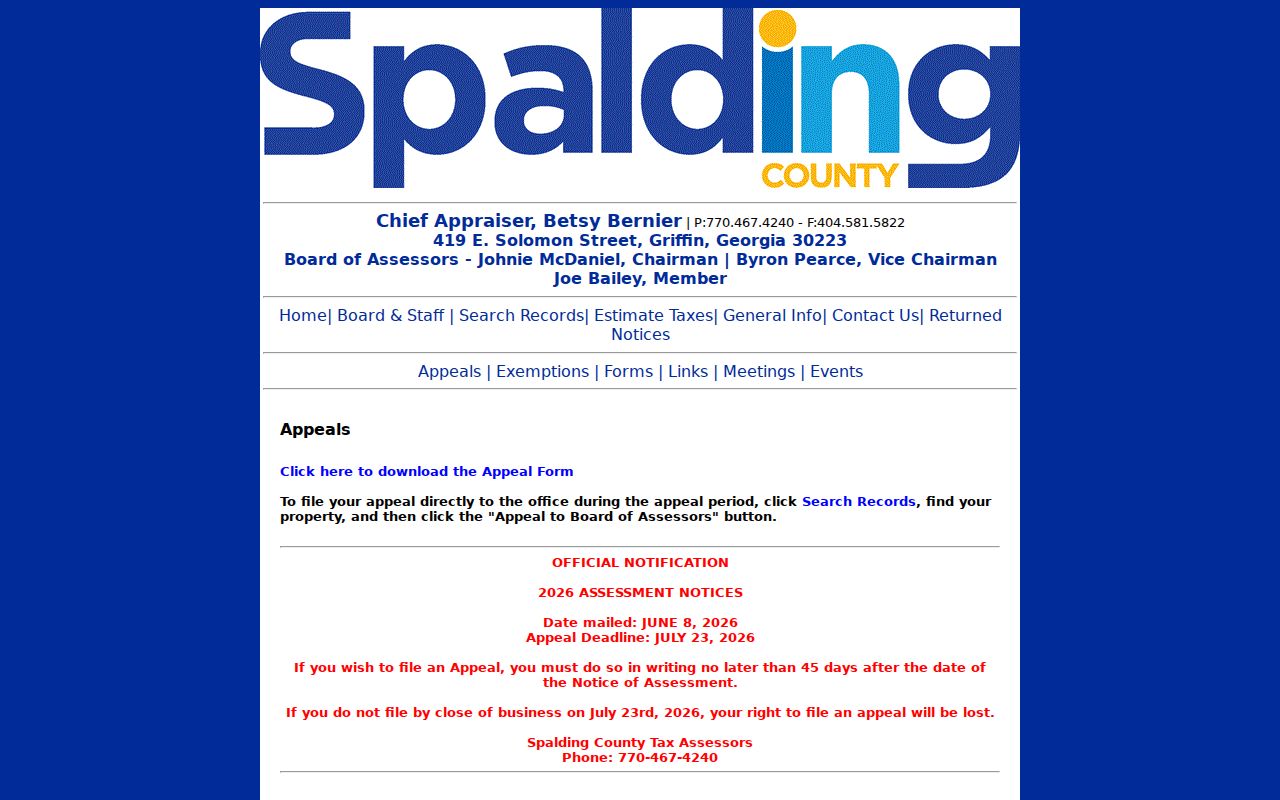
An appeal date always belongs to its own tax year. A past deadline should not be read as a standing rule for future notices.
Appeal window. Use the deadline printed on the current notice. The 2026 Spalding deadline was July 23, not a standing date for later years.
Assessment and collection records should always share the same tax year. A current parcel card paired with an older bill can create a false mismatch. The mismatch may show in owner, value, exemptions, or district. Save the notice year, bill year, parcel ID, account number, and access date. If ownership changed, remember that the assessor roll can lag the newest recorded deed. The county publishes no fixed refresh interval for its roll.
Exemption research begins with the code and amount shown on the assessment record. Homestead, age, veteran, disability, conservation, forest, or historic treatment can affect taxable value. Each affects it in different ways. Eligibility and filing requirements belong to the assessor's current instructions. An exemption does not change the deed, parcel geometry, or full fair market value. It merely reduces the taxable base.
Delinquency needs its own dated check. The Tax Commissioner FAQ describes interest and penalty rules, but statutory application can change. Ask for the current balance and payoff information rather than calculating from an old screen. If the parcel appears on a tax-sale page, preserve the advertisement. Then verify whether the sale is scheduled, withdrawn, completed, or followed by a recorded tax deed.
Appeal evidence should address the ground selected. Comparable sales may support value. Similar assessments can support uniformity. Documents about use or ownership may bear on taxability or exemption. Photos, measurements, repair estimates, and permit history can explain physical facts. A tax bill complaint by itself does not replace a timely appeal. It does not replace an appeal of the assessment notice.
When the assessor and tax account disagree, contact the office responsible for the field. The assessor handles identification, class, value, exemptions, and appeal records. The commissioner handles billing, payments, delinquency, sale status, and excess funds. Give the parcel ID, tax year, account or bill number, and the exact field in question. Keep the response with the original screen. That way a corrected value or payment status stays tied to its date and source.