
Deed Types Recorded in Spalding County
The Clerk of Superior and State Courts records the instruments behind Spalding County's real-estate trail. A deed marks a recorded conveyance. But its type and legal text decide what interest actually moved. Security deeds, liens, assignments, cancellations, easements, covenants, plats, affidavits, and powers of attorney round out the file. None of these necessarily change who holds title. Those extras give each parcel's deed records their fuller story.
| Deed Type | What It Does | Common Use |
|---|---|---|
| Warranty deed | Conveys the stated land with warranties in its text | Ordinary sale |
| Quitclaim deed | Conveys whatever interest the grantor has | Interest cleanup or family transfer |
| Limited warranty deed | Uses warranties limited by the instrument | Some business or estate sales |
| Executor or trustee deed | Records a fiduciary conveyance | Estate or trust transaction |
| Tax deed | Records a transfer following the tax-sale process | Delinquent-tax property |
An encumbrance is a recorded claim or burden on land. A security deed or lien fits that definition. It is not the deed that conveyed ownership. Treat each item carefully. Check the party role, the instrument type, and the legal description. Also check any related recording references before you add a filing to a chain of title.
Spalding Clerk Holds the Record
The Spalding County Clerk of Courts serves as the recording custodian for property records. The real-estate office sits at 132 E Solomon Street in Griffin. Mail is handled at PO Box 1046, Griffin, GA 30224. Published hours run Monday through Friday, 8 a.m. to 5 p.m. For real-estate and UCC questions, call 770-467-4356.
Requests move faster with specifics. Give the book and page. Alternatively, offer an instrument number, party names, a recording date, or the parcel legal description. Say whether you need a plain or certified copy, and whether the request involves a deed, security deed, plat, release, easement, or several linked filings.
The Clerk's official page lists the local records office and its public resources.
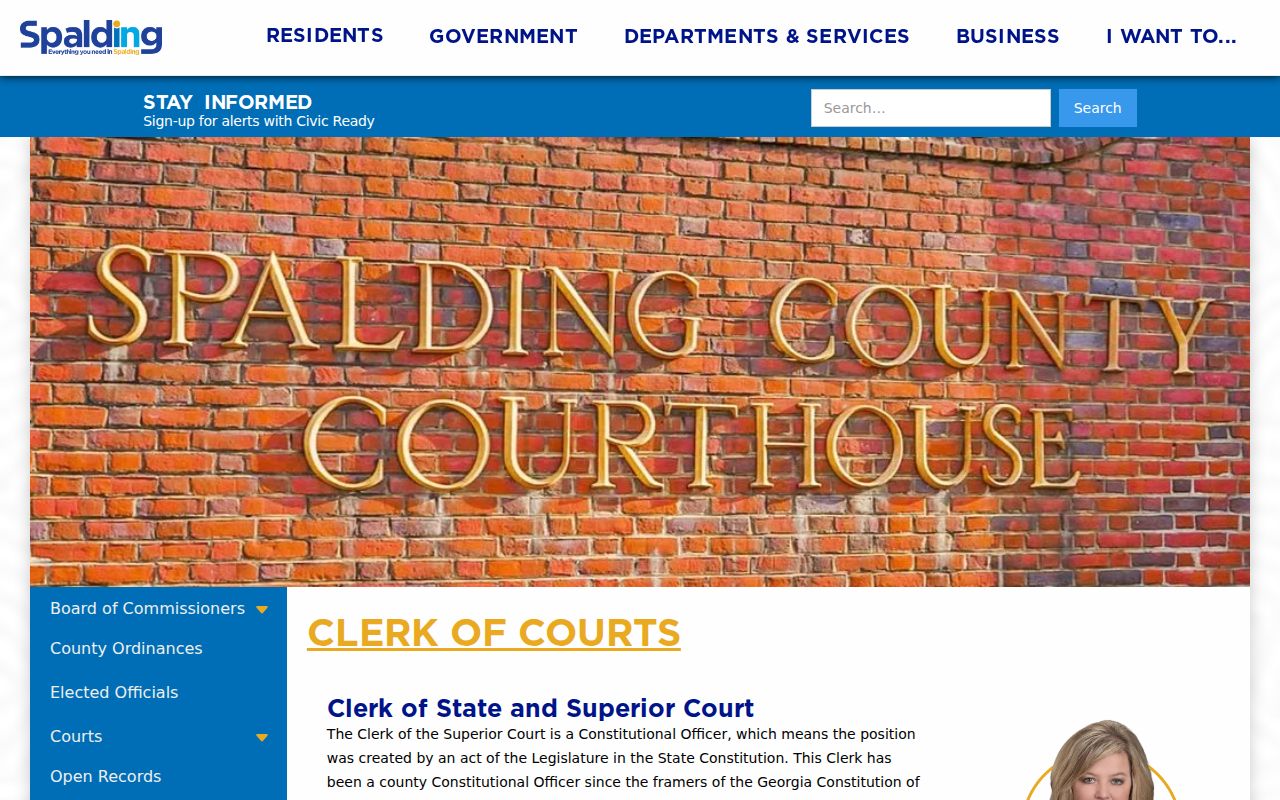
The Clerk's own index controls whenever a statewide index tells a different story about a Spalding County filing.
Search Spalding Grantor-Grantee Records
The GSCCCA name search takes a party name, party type, instrument type, county, date range, and display options. A grantor conveys an interest; a grantee receives it. Searching both roles is the backbone of any chain-of-title review.
- Find the current owner's acquiring instrument with that owner as grantee.
- Read the grantor, legal description, date, and book/page from the deed.
- Search that grantor as a grantee in an earlier date range, then repeat.
- Compare each legal description and move to deed books when the online span ends.
- Grantor
- The party conveying the stated interest.
- Grantee
- The party receiving the stated interest.
- Chain of title
- The linked sequence of conveyances for the same land.
- Book/page
- A recorded location used to retrieve a document.
Spalding Deed Index Fields
Exact legal names give the best name-search results, followed by variants. Entity suffixes, middle initials, estates, trustees, and representative roles can all hide a match. Book and page search needs the county plus the book and page. A date range is an option. Property or subdivision search helps where participating records carry those terms.
| Field | Use | Caution |
|---|---|---|
| Party | Grantor or grantee name | Try variants |
| Instrument | Limit the record type | Do not omit related liens |
| County | Choose Spalding | Land descriptions may cite old boundaries |
| Date | Narrow the filing span | Execution and recording dates differ |
| Book/page | Retrieve an exact citation | Confirm against the official image |
PT-61 transfer data can hint at a sale. GSCCCA states it is not the official real-estate filing, so verify the deed itself.
Spalding Deed Records Before 1989
The Spalding good-thru table lists local online coverage. It starts January 1, 1989 and runs through September 2, 2026. The statewide service's general description cites at least 1999 for all counties. Treat the local table as the operational guide for Spalding County deed records. Keep both statements in mind.
For older deeds, start with the Clerk's deed books and counter. The Georgia Archives research route and FamilySearch catalog aids can deepen the work. Archives materials may add deeds, estates, taxes, courts, and microfilm context. They do not replace the recorded chain the Clerk holds.
Online depth. The 1989 start is an index-coverage marker, not a claim that older Spalding County deeds do not exist.
Images, Accounts, and Fees
GSCCCA allows participating-county images to be viewed under its account rules. Published prices included $14.95 per month for a regular account. A $5 single-use activation was good for four hours. Printed image pages ran $0.50 each, and Premium cost $29.95 per month. Prices can change. Confirm them before you buy.
Even without an image, an index result captures the party, date, instrument, and book/page. Contact the Clerk for current plain-copy and certification costs. The county publishes no certified-copy schedule online.
Plats and Easements in Deeds
A deed may convey a full tract, a partial interest, or an easement rather than a whole tax parcel. Follow every citation the instrument offers. Plat book, deed book, lot, phase, land lot, district, metes-and-bounds, covenant, and prior-deed references all belong in the reading. A tax parcel is an assessment unit, and it may not match the estate described in a single instrument.
Spalding planning records show why labels matter. Crestwick Phase 2 cites parcel 231 01011, deed book 4788, and plat book 24 page 498. Its legal description notes land originally in Monroe and now in Spalding. That historic geography belongs in the reading itself, not as proof of a modern county change.
Watch Spalding Property Filings
GSCCCA FANS provides free, forward-looking alerts built on name, address, or document criteria. It can flag a new filing for review, though it is voluntary, may not be complete or current, and cannot repair title.
The official FANS page presents the statewide enrollment route.
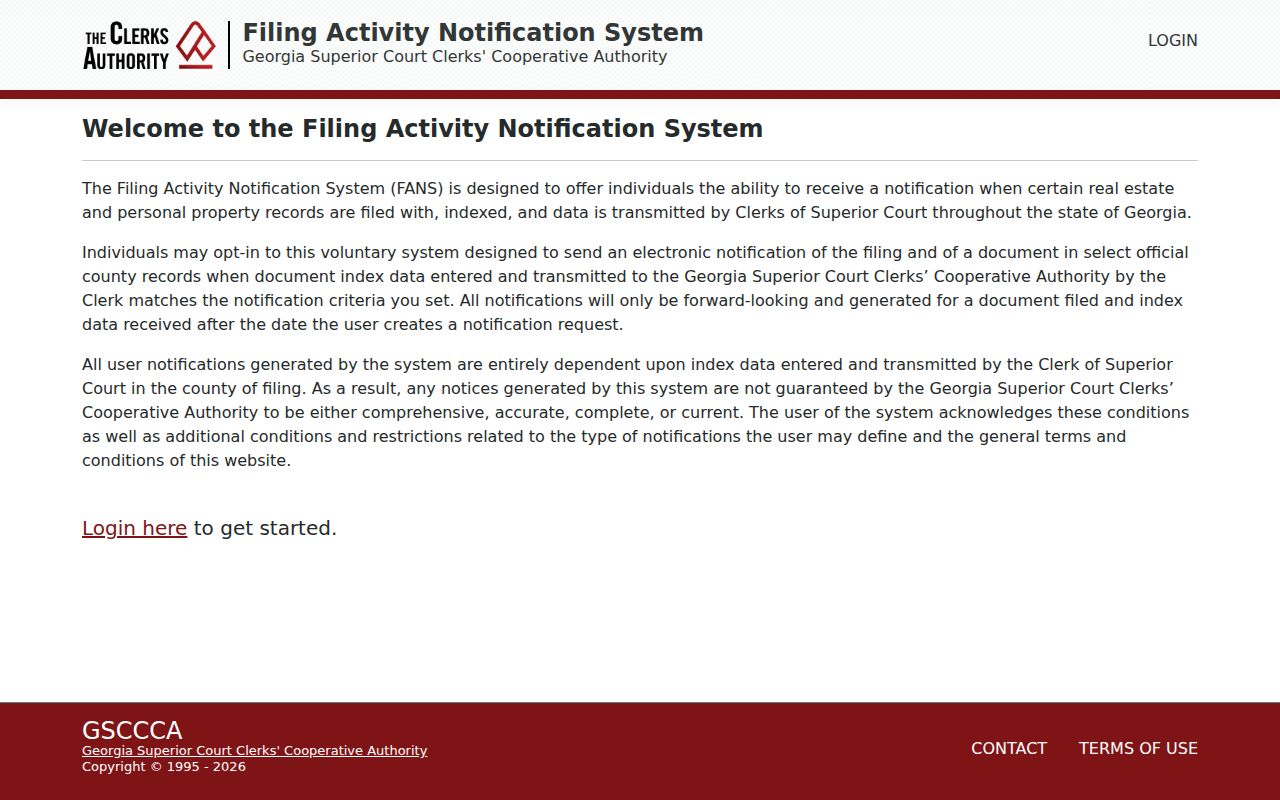
The alert service is not the deed index. Every alert still calls for review of the actual recorded filing.
Georgia's title-theft guidance also stresses identity checks and careful review of unsolicited real-estate communications. If an alert looks wrong, keep the notice. Contact the Clerk to examine the instrument on record.
Security Deeds Are Not Owners
Security deeds, assignments, cancellations, and releases are filed right alongside conveyance deeds in Spalding County. That mixing trips up careless readers. A security deed documents debt. An assignment can shift the lender's position. Yet the owner of record keeps the same title interest. Nothing has transferred. Check the instrument type before treating any indexed name as part of the ownership chain.
A release often points back to an earlier security deed by book and page. Liens, judgments, covenants, and rights of way burden land too. Each demands its own reading. Follow the related references and confirm against the official recorded image.
Record a Defensible Deed Trail
For every link in the chain, capture the essentials. Record the execution and recording dates, grantor, grantee, instrument type, book and page, legal description, consideration clue, and prior references. Deeds vary widely in scope. One may convey a single lot, a split, an easement, a partial interest, or several parcels at once, so compare the tract and not just the people.
Older Spalding County deeds predate current parcel IDs. Bridge that gap with plat citations, land lots, districts, courses, and adjoining owners. A PT-61 form can hint at transfer tax or sale price. Treat it as a clue only. The recorded deed remains the authoritative public conveyance record.
Obtain a Spalding County Deed
Start with the online image whenever one is available. No image? Jot down the book and page. Ask the real-estate desk at the Clerk's office. Counter and mail requests both work as fallbacks. A request should say up front whether certification is needed. Give enough identifiers to avoid paying for a broad search of Spalding County deed records.
When the exact citation is unknown, supply both party names and an approximate recording range. Include the instrument type, the parcel description, and any known prior references. Georgia's Open Records Act also supports requesting public records. Those records must already exist in files outside an index. Such requests remain subject to statutory exemptions and lawful charges.
Recorded, not guaranteed. Spalding County deed records show filed instruments. They do not give a title opinion, resolve every unrecorded interest, or replace legal review.
A complete deed request names the instrument and its citation. Give the Clerk the county, book and page or instrument number, grantor, grantee, recording date, and parcel description. Say whether a plain image or a certified copy is needed. If the record is actually a plat, release, security deed, easement, or restriction, state that clearly. Otherwise the request gets mistaken for a single warranty deed.
Chain research should track the land as closely as the names. Compare lot, block, phase, land lot, district, acreage, metes-and-bounds calls, adjoining owners, and prior deed references. Do this at each step. A parcel split or a combined assessment can break a tidy name-to-name chain. Suffix letters and new parcel IDs are clues. Pull plats and parent tracts from them. They are not proof the land left the chain.
Estate and foreclosure instruments call for role checks. An executor, trustee, lender, borrower, tax-sale defendant, and successful bidder each appear for different reasons. Read the authority and the instrument type. Probate or court files may explain a transaction. The deed records the conveyance itself. Not every indexed party is a former owner.
For research before 1989, bring the last verified online deed to the counter. Follow its prior book/page citation backward. Search the reverse and direct deed-book indexes. Then compare the legal description at every step. Georgia Archives and FamilySearch can point to older county volumes or microfilm. Even so, the Clerk's official record remains the final confirmation for a Spalding County title trail.
Keep an index worksheet even when images are online. One row per instrument should log the source URL, access date, county, party roles, instrument type, execution and recording dates, book and page, parcel description, and links to prior instruments. Mark each match as provisional. Hold that status until the legal description is compared. This discipline exposes skipped generations, partial tracts, releases mistaken for transfers, and two parties with similar names. It also hands the Clerk a precise list whenever an image is missing or certification is required.